“Don’t be too timid and squeamish about your actions. All life is an experiment. The more experiments you make the better.”
Ralph Waldo Emmerson

How I Became a Therapist
A story of horses, behaviour, learning, change — and finding my way to therapy.
The Early Years
I grew up on cattle properties west of Mundubbera in rural Queensland, where horses, cattle, dogs and the bush were simply part of everyday life. I was riding before I can remember learning how — my earliest memory is cantering away on my pony Minnie, who had apparently decided she was taking us both back to the yards.
Looking back, those years gave me my first education in behaviour long before I knew to call it that. Animals were not something I visited occasionally; I lived alongside them. I watched how they learned, what frightened them, what settled them, how individuals responded differently to the same situation, and how communication occurs without words.
Horses became the constant thread. As I grew older, riding became competition, competition became coaching, and eventually what had begun as a childhood way of life became a profession.
 |  |  |
|---|---|---|
 |  |  |
Learning the Equestrian Craft
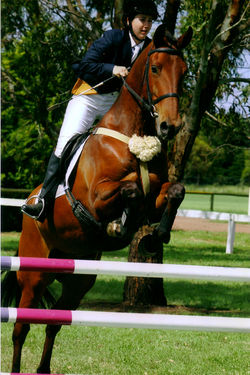
By my teenage years, horses had become much more than something I loved. I was competing seriously across show jumping, dressage and eventing, while also beginning to coach through Pony Club.
After school, I deliberately sought out places where I could learn from people with more experience than me. I completed formal equestrian business training at Marcus Oldham College (Diploma of Horse Business Management ~ 2004), spent time working in New Zealand, and then worked as a pupil and groom in professional show jumping and eventing yards in New South Wales (Diamond B Farm & Falcon Sport Horses).
Those years were my apprenticeship. I learned through long days, repetition, observation and responsibility — riding different horses, seeing different systems, and gradually developing my own judgement rather than simply following instructions.
I also completed my Equestrian Australia coaching qualification during this time. By the time I returned home, I wasn't just someone who had ridden horses all her life. I had begun the transition into a professional horsewoman, trainer and coach.
 |  |  |
|---|---|---|
 |  |  |
 |  |  |
 |  |  |
 |  |
A Professional Horsewoman
When I returned to Queensland, I established my own horse training, breeding and coaching business. For the better part of a decade, horses were my profession: starting young horses, retraining established ones, coaching riders, breeding performance horses and continuing to compete.
Those years gave me breadth, but they also made me increasingly curious about why training worked. I had learned many effective techniques from excellent horsepeople, but I wanted to understand the mechanisms underneath them rather than relying on tradition or intuition alone.
That curiosity led me to Equitation Science and a Diploma in the field. Learning theory gave language and structure to things I had been observing for years — how behaviour is learned, how responses are reinforced, how stress affects learning, and why clarity and consistency matter.
I later spent eighteen months working professionally with horses in Germany, riding horses from young and green through to advanced levels. By then, my practice had changed considerably. I wasn't simply asking, “How do I get this response?” I had become much more interested in “Why does this work — and what is happening for the individual in front of me?”
That question would eventually take me somewhere I hadn't expected.
 |  |  |
|---|---|---|
 |  |  |
 |  |  |
 |  |  |
 |  |  |
 |  |  |
 |  |  |
 |  |  |
 |  |  |
 |  |  |
 |  |  |
 |  |  |
 |  |  |
 |  |  |
 |
The Dark Night of the Soul
Eventually, the life I had built around horses stopped fitting.
I was working incredibly hard and, in many ways, riding and training better than I ever had. But the kind of calm, evidence-informed training I believed in wasn't particularly fashionable at the time. People often wanted the results, but not necessarily the departure from tradition required to get there. I found that both frustrating and endlessly perplexing.
At the same time, the practical reality had become unsustainable. I didn't have a property of my own, I was moving from farm to farm, working constantly and still struggling financially. Somewhere in all of that, I became deeply unhappy, anxious and depressed.
Eventually I saw a therapist. She changed my life.
For the first time, I began seriously asking what actually makes a good life — not simply a successful one, or one built around something you love. I knew I couldn't keep going as I was, financially or emotionally, and I wanted a completely different future: meaningful work, financial stability, and eventually the freedom to have horses in my life simply because I loved them.
University seemed like a sensible place to begin. Psychology was the only subject that genuinely interested me.
Strangely enough, it didn't feel like such a dramatic leap. Equitation Science had already taught me to look beneath behaviour and ask why it occurs. Coaching had taught me that knowing something yourself and helping another person understand or change it are very different things.
I had spent years trying to understand horses. Increasingly, I found myself wanting to understand people.
Becoming a Therapist
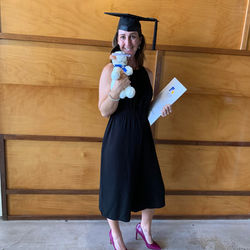
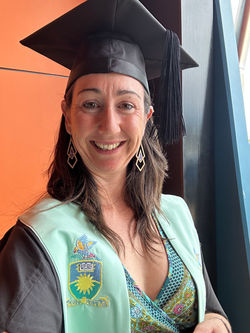
I initially enrolled in Business and Psychology, but quickly discovered that studying online wasn't for me. Looking for a face-to-face alternative brought me to the University of the Sunshine Coast, where a combined Counselling and Psychology program seemed like a good fit.
Starting counselling was something of a revelation. Psychology fascinated me, but counselling was what I had imagined studying psychology would feel like. It was practical, relational and applied. In some ways, it felt surprisingly familiar to coaching: knowledge mattered, but so did the ability to sit alongside another person and help them make sense of something for themselves.
I came to value both disciplines, but eventually decided to finish my counselling degree and begin working. After years of study, I was ready to actually become a practitioner.
Life had a few more turns in store. I became a mother, returned to the Goomeri region, and completed my Bachelor of Psychology through CQUniversity. I remain deeply grateful for that education — psychological theory continues to provide an important foundation beneath my therapeutic practice.
Returning home also created an opportunity I could never have planned. I was approached by a local community organisation about supporting a father involved with Dept of Child Safety who was working towards reunification with his daughter.
I said yes.
That work became the beginning of my clinical career — and brought me face-to-face with the complexity of trauma, attachment, parenting, family relationships and the ways our histories continue to shape our behaviour.
 |  |  |
|---|---|---|
 |  |  |
 |  |  |
 |  |  |
Trauma & Attachment Therapist
As my clinical career began, I found myself at the coalface of raw human behaviour and suffering — a place where behaviour can become difficult to understand. Trauma, attachment disruption, dissociation and protective responses can create behaviours that don't always make sense from the outside, and patterns that repeat despite a genuine desire to change.
My early therapy training taught me how to sit beside someone with compassion. But my life with horses and as a coach made me want to understand more. Horses had taught me that behaviour does not occur in a vacuum, and that understanding and treating causes is far more useful than simply responding to symptoms. I wanted to move beyond asking “What is wrong with this person?” and better understand the mechanisms underlying human behaviour — so I could help people create meaningful change.
My behaviourist roots kept me searching through therapeutic approaches and eventually led me to Trauma-Informed Stabilisation Treatment (TIST). In TIST, I found something surprisingly familiar: a framework for understanding human behaviour that did for my therapeutic practice something similar to what Equitation Science had once done for my work with horses. Behaviour isn't entirely unique, unpredictable or random. When we understand what sits underneath it, recognisable patterns begin to emerge.
That understanding has become central to the way I work.
My practice today is grounded in person-centred, trauma- and attachment-informed therapy, alongside a strong understanding of behaviour and learning gifted to me through years with horses and coaching. I love complexity, and I am particularly interested in helping people make sense of patterns that feel confusing, contradictory or deeply entrenched — not so they can excuse them, but so they can understand them well enough to create something different.
For me, therapy is not simply about unconditional positive regard. I believe lasting change often requires understanding why the lever works when we pull it, why the button works when we push it, and what keeps us reaching for the same old behaviours under stress even when we desperately want to do something new and different.
The subject has changed. The framework has not
Life Now
These days, life has come full circle in ways I couldn't have planned.
I live on a small cattle property in rural Queensland with my daughter and Mum, where, in my spare time, I am slowly building a Braford stud and creating the kind of grounded country life I never thought I would find my way back to.
Horses are still here too — no longer responsible for paying the bills, and more precious because of it. They remain part of who I am, without needing to be all of who I am.
My work as a therapist, my life on the land, motherhood, cattle, horses and an enduring curiosity about the mechanisms of a good life all sit alongside one another now.
A final note: I have been fortunate to be guided by many people along the way. None of us gets anywhere entirely alone. If you need support, please never hesitate to reach out.
 |  |  |
|---|---|---|
 |  |  |
 |  |  |
 |  |
